| Name | Value | Metric |
| Salah | 37 | Goals |
| Salah | 10 | Assists |
| Salah | 62 | Shots on Target % |
| Salah | 38 | Shots off Target % |
| de Bruyne | 11 | Goals |
| de Bruyne | 20 | Assists |
| de Bruyne | 58 | Shots on Target % |
| de Bruyne | 42 | Shots off Target % |
Wednesday, 4 April 2018
Tuesday, 27 March 2018
The BBC Sport Chronicles: Part 2
Anonymous
01:58
data viz, dataviz, football, makeover, soccer, visualisation, vizualisation
No comments
Drawing from this article by Phil McNulty (http://www.bbc.co.uk/sport/football/43463551), there is a section where McNulty focusses on the conundrum around England goalkeepers, and who should wear the number 1 jersey at the World Cup.
And as part of this piece, was this wonderful bar chart;

The data is from opta, and each goalkeeper is grouped by the relevant number used. However;
- How easy is it for me to compare the goalkeepers for clean sheets?
- How easy is it for me to remember which colour bar refers to which metric?
- What is the takeaway message here?
| Metric | Player | Value |
| Appearance | Butland | 27 |
| Clean sheets | Butland | 5 |
| Goals conceded | Butland | 49 |
| Appearance | Hart | 15 |
| Clean sheets | Hart | 3 |
| Goals conceded | Hart | 33 |
| Appearance | Pickford | 30 |
| Clean sheets | Pickford | 7 |
| Goals conceded | Pickford | 49 |
| Appearance | Pope | 27 |
| Clean sheets | Pope | 10 |
| Goals conceded | Pope | 22 |
Thursday, 19 October 2017
Why your understanding of ‘elite mentality’ is false, and how data can help solve this problem.
Anonymous
16:10
data, elite mentality, football, soccer
No comments

In recent years, there’s been a rise in the usage of the term ‘elite mentality’ - particularly in the world of football (soccer). The application, in the way the term is used, is to describe someone who is a good player, but not ‘elite’ because they don’t have a winning mentality. This is measured by the number of finals they’ve won, and medals they have etc etc yada yada yada.
I disagree.
Like big time.
Cavani, Higuain, the Argentinian national team, Tottenham Hotspur… often are often all called bottlers who don’t have this “elite mentality.” Players who aren’t good enough; aren’t champions; aren’t
Poppycock.
Sport is about winning, ultimately. But sport is wonderful, beautiful and engrosses billions. And for many, an “elite mentality” is where a player, individual or team are able to win regularly, consistently and in style.
However - If an elite mentality exists, in my eyes, and perhaps even in a coach or even player/ex-player, it doesn’t come from what you win. It comes from how you grow through your career.
Goal Setting
[‘Big Brother’ surveillance in elite sport is pushing a culture with a machine mentality](http://theconversation.com/big-brother-surveillance-in-elite-sport-is-pushing-a-culture-with-a-machine-mentality-34214)/2012%2F12%2F04%2Fe0%2Fsurveillanc.b8u.jpg)
The above article talks about how surveillance is focussing on tiny flaws to ridicule managers. This is of course a by-product of any data - that with the right context or framing, it can be used to push a certain narrative.
But data can be incredibly useful - particularly when it can enable sports professionals to begin to quantify the unquantifiable - which in turns adds another layer of information to consider when diving into player or team analysis.
Let’s take an example.
I am a coach of a professional football team’s academy, and I have 6 players I’ve earmarked for progression into the first-team. But all have flaws.-> The striker attempts to dribble for as long as possible and usually ends up being dispossessed due to trying flair moves
-> The wide midfielder in my academy enjoys cutting inside and shooting speculatively, rather than looking for the pass.
-> The central defender always thumps it clear, rather than starting an attack.
All of the above can be coached, but with the emergence of data, this progress can be tracked to see which of these players possesses the mentality & hunger to continually progress.
By this, I mean a player who not only is looking for coaches to tell him his strengths and weaknesses, but is one who will consistently and constantly look to improve.
Data can be combined with human coaching to show a player situations where they should change their decision making process, and even for coaches highlight areas where approaches can be gamified in training sessions.
Get the first player to pass at least twice and show him the value he can bring when 1-on-1 with more space to exploit.
Coach the second player to think twice before letting fly with the rocket, with a ‘points’ related coach (merits for ‘good’ locations, demerits for ‘less good’)
Work with the third player to improve their own the ball confidence and technical ability.
Talent Identification (TID) is the intricate art of wanting to use data to help highlight the right time to bring a player through the ‘funnel’ to first team football. Based on precedent, it’s then possible to build an understanding of what key factors are in tagging development, and how to best nurture talent.
Harry Kane
The strange rise and rise of Harry Kane was highlighted by the contrasting views - on one hand, you had the Kane hype train which was highlighting the second coming of a true world class striker; the others were saying it was a freak season due to the previous ‘failings’ of the striker on loan spells at Norwich, Leyton Orient and Leicester.
But amongst these loan spells, coaches spotted something in his game which they wanted to nurture. If you recall, Kane often started as a CAM, as well as a CF when he came through the academy - which is strange now looking back given his propensity to be a baller when it comes to finishing chances.
How can we find players with Kane’s mentality? Who have a hunger to develop, and which cannot be spotted in their on-field outputs, but simply from their responses to coaching, viewing how they apply recommended changes and their drive to improve.
What can clubs do now?
A super duper smart analytical approach will combine the expertise, experience and nous of a coach/scout with the vast amounts of data being collected in order to learn to be smarter with decision making.Are there markers to help spot talent?
Can training session events be logged, and used in tandem with on-pitch output to track progress toward goals?

How can the qualitative match the quantitative to improve conversations had internally? Can this ensure a club doesn’t pay over the odds for an average player by simply bringing a existing expertise together with existing data?
The dream, as they say, could be getting to a level of data and competence where key markers are used to time purchases of players to capture the upward peak of their career.
Now that would be elite.
Monday, 10 July 2017
Visualisations in the Wild - Sky Sports can do better
Anonymous
14:59
dataviz, football, makeover, sky sports, soccer, visualisation, visualization
No comments
Player
|
Mins
played
|
Shot
conversion %
|
Goals
per 90 (exc. Pens)
|
xG per
90 (exc. Pens)
|
Lacazette
|
2,408
|
33.3%
|
0.67
|
0.47
|
Sanchez
|
3,223
|
18.6%
|
0.61
|
0.42
|
Giroud
|
1,194
|
30.8%
|
0.9
|
0.51
|
Walcott
|
1,925
|
16.1%
|
0.47
|
0.36
|
Welbeck
|
746
|
10.5%
|
0.24
|
0.38
|
Perez
|
265
|
11.1%
|
0.34
|
0.27
|
Iwobi
|
1,462
|
7.69%
|
0.18
|
0.18
|
Saturday, 21 January 2017
Fair, or Foul?
Anonymous
14:31
analytics, cards, data, football, fouls, referees, soccer, sports, tableau
No comments
Referees have a damn hard job in football, and the last few weeks, with Mike Dean being "demoted" (how does this even work? how is working in a similar environment, with perhaps more incidents per game in the Championship work? why is this a demotion? The answer, as ever, is money, power and exposure. But I digress) the work referees do and how they perform is increasingly important.
There's a couple of things which have been on my mind lately, and it stemmed from someone in the Analytics community (I spent a bit looking for the actual tweet in question, but couldn't find it...) saying how Ander Herrera is notoriously effective at fouling multiple times without picking up a yellow.
Within this, I've look at fouls/fouled per game, yellows and reds per game as well as the number of fouls committed for every card received. Let's get stuck in.
I'll post the dashboard here, and if you scroll down, you'll find discussion points from me, with a few screenshots.
The first story point (there are two, one in each tab along the top), focuses on a scatter plot. This contains every team from every league mentioned above for this season (before the round of games for the weekend of 21st Jan 2017)
On one axis is the cards per game, and the other has fouls per game. Tab through and find your own team, and compare it across the leagues.
The second set of charts is the dot-plots, and I've added a median line, with an confidence interval of 95%. These I've gone through in a bit more detail below.
Fouls per Game
When we look at fouls, we then have to look at how trigger happy referees are when pulling out their cards. La Liga has the highest number of cards awarded across the league, whilst referees in the Eredivisie and Ligue 1 1.5-2 cards per game.
Fouls per Card
The danger here, of course, is inferring that teams which foul and are carded less are lucky, and those who foul less and are carded more and unlucky - what if the latter have some tough tacklers who often make bad challenges? What if the former are pushes in the back, and body checks by various players across the teams. This is where the data should be investigated to explain the phenomenon. Drilling down to player level will support this.
What's the point? Where's the value?
With any sort of data analysis, particularly in sport, there are two key questions. The first is, what's the point in doing it? The second is, if this is useful information, how can we use it to our advantage as a team?
The answer to the first question is simple; there are certain teams across every league with a style of play where tactical fouls are common. Is this because of their aerial style of football? That they play with 2 robust central midfielders or defenders? Or are they simply bullies, who have the ability to shut down flair players through sheer physical player.
This doesn't even start to answer those follow up conversations or questions, but it does do something quite key - it starts those conversations. It gets people thinking from a set of basic metrics which are easy to understand. And this is where true buy in can begin within clubs, and indeed, within fan bases.
As a team, the advantage of this information would be for a pre-match scouting report. How can this help us identify the style of play that the team plays? One step further... Who are the key players who help them play like this? Again, basic analysis breeds the desire for more context to inform better, smarter decisions - and in a shorter space of time. And further? Once you start getting a good idea, a smart analyst would begin to look at manager styles (hat tip to Statsbomb Services who advertise that they do this sort of thing), and then even look at referee styles & data, to see if that can be gamed. Edges and gamification of league rules.. That's the way sports teams get ahead, right?
Have a play with the dashboard above, and do be in touch any thoughts, ideas or feedback.
Monday, 27 June 2016
Fast start or frustration; England vs. Iceland preview
Anonymous
08:00
analytics, england, football, soccer
No comments

I maintain this; that this team that Hodgson has been putting out, and the system being deployed is the best I've seen in in my life as an England fan. It's just good to watch - it has balance, players who have a good amount of quantity - Arguably no sexy individuals who you throw on to *be* the game, but I do feel that there are some class players in the setup; Daniel Sturridge, who on form is the best English striker; Eric Dier, a player in which England may have finally found their deep-lying pivot; Danny Rose, a strong left sided defender who may be the answer to finally replace Ashley Cole - And on the right, there's a battle between Nathaniel Clyne and Kyle Walker. Couple that with the different variations possible with players like Lallana, Alli, Henderson, Rooney, Kane, Vardy and Sterling... Good problems.
So tonight England play Iceland - The fairytale team. How many times have you heard about the size of their population, the feel-good nature of their team and who can forget that commentator when they scored in the last minute? As the kids say, "Scenes."
But England are going HATE playing against them.
Deep lying defences
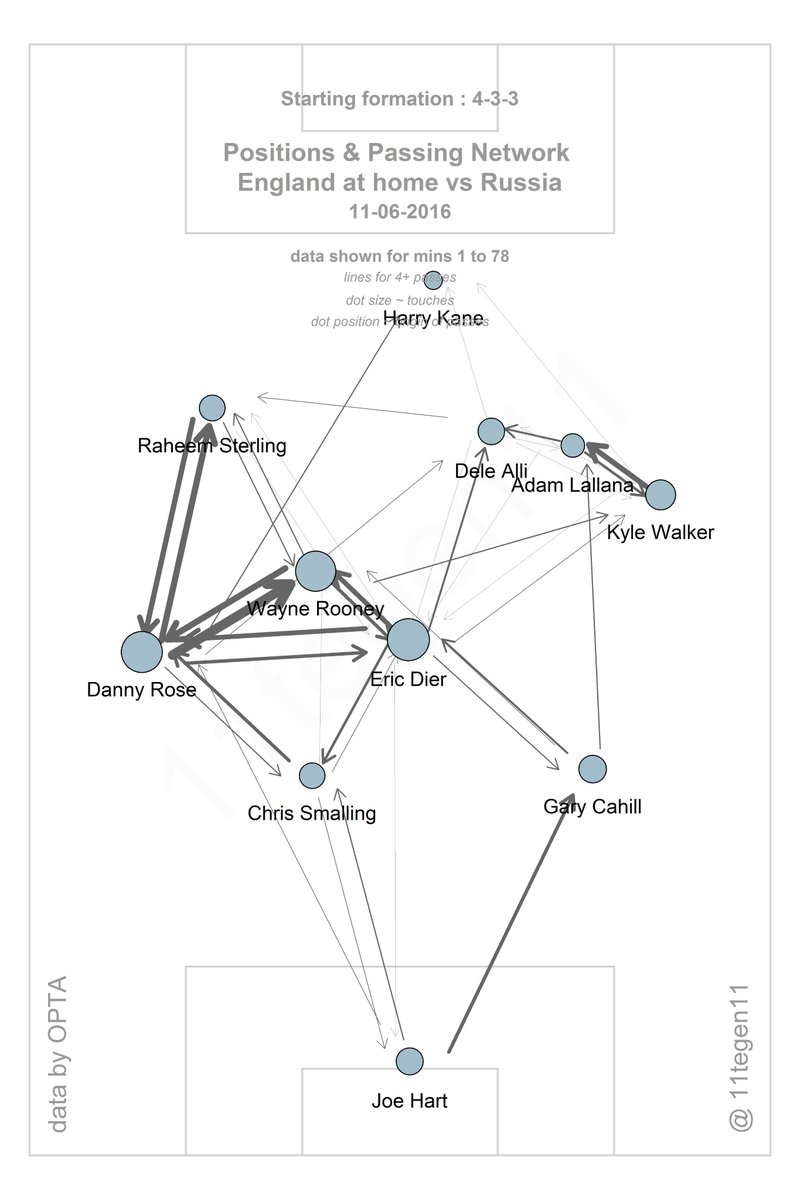
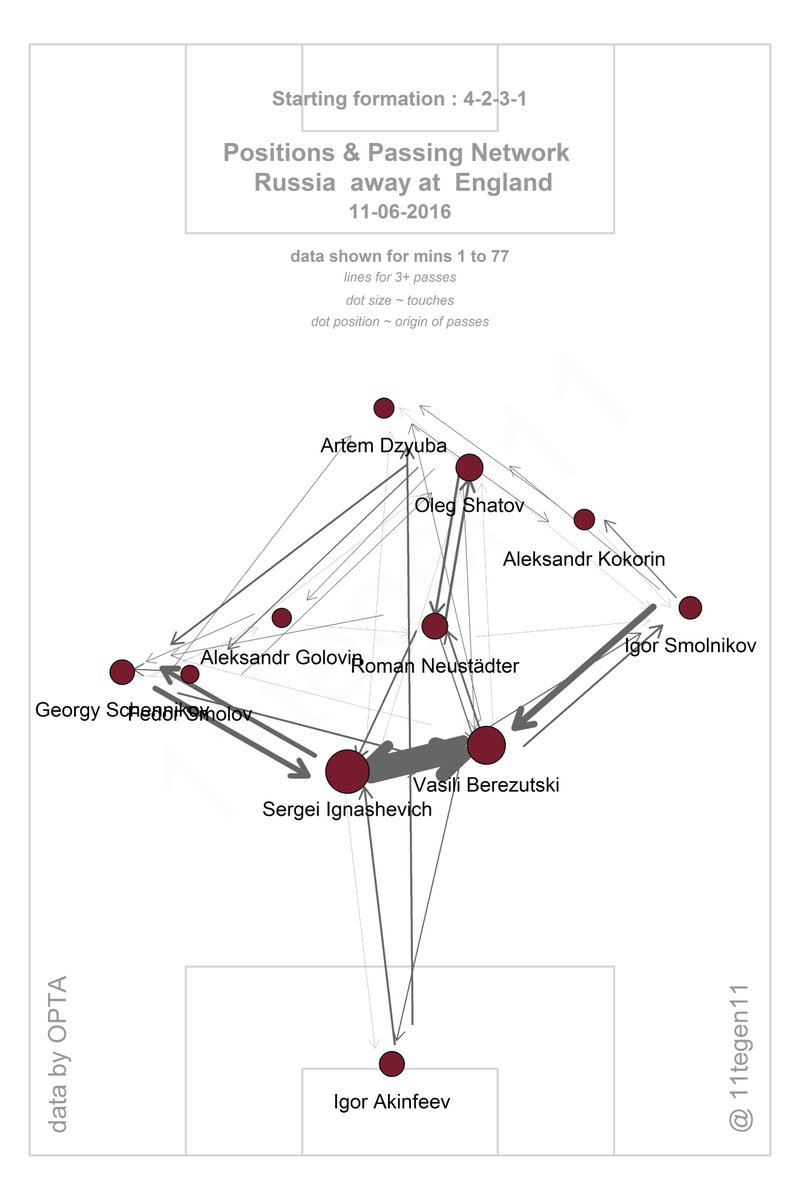
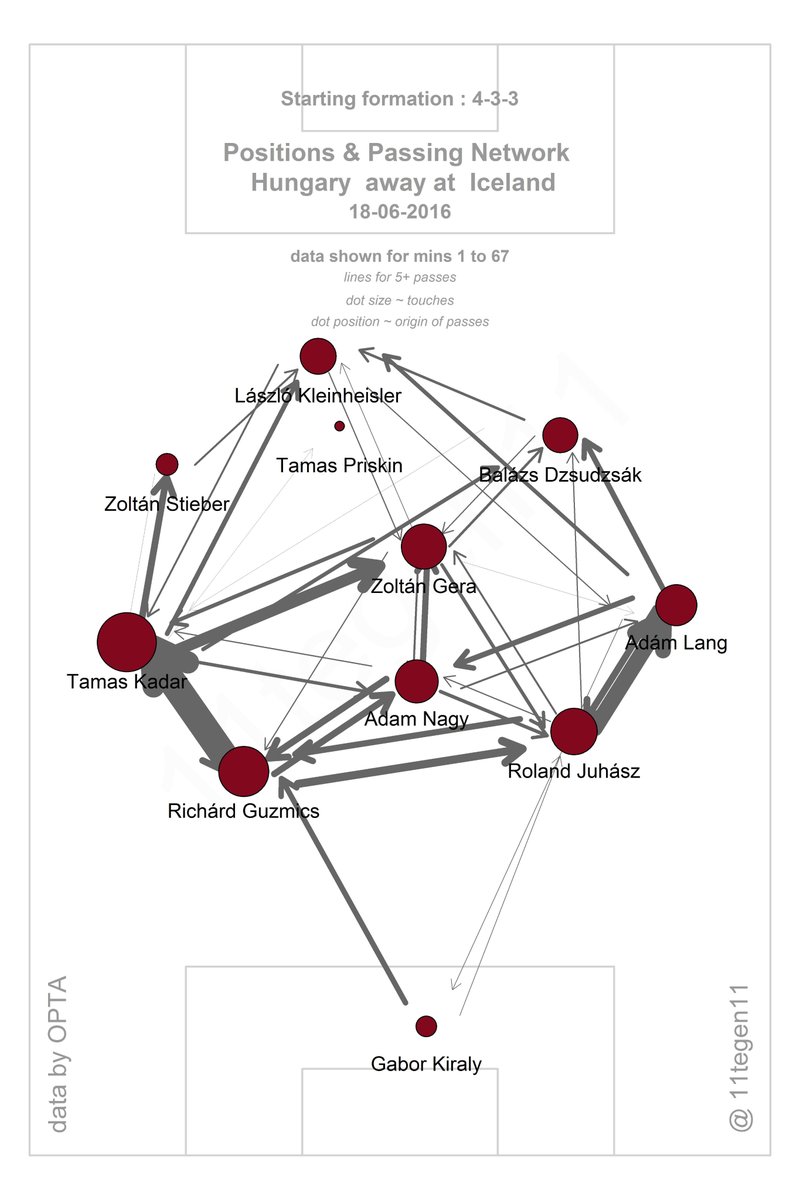
In the group stages, England have been unfortunate to play three teams who were a) happy to not have the ball, and for one reason or another b) happy to sit deep and let England attack them. This is not good news, particularly for a country where fans and media are disgusted by wages, perennially pessimistic and fans sit in pubs slapping the table yelling "Just do something!", "How hard can it be?!", "My nan coulda scored that!" while shaking their head, moments before someone amongst their group wisely notes "This team is crying for a plan B - where's Andy f*ckin Carroll?!" (I'm looking at you Glenn Hoddle)The hardest part of this is the penetration - Against Russia, there were 4 defenders PLUS the two sitting midfielders, with the centre-backs barely venturing a few yards away from the 18 yard box they were defending. (Passing networks via @11Tegen11)


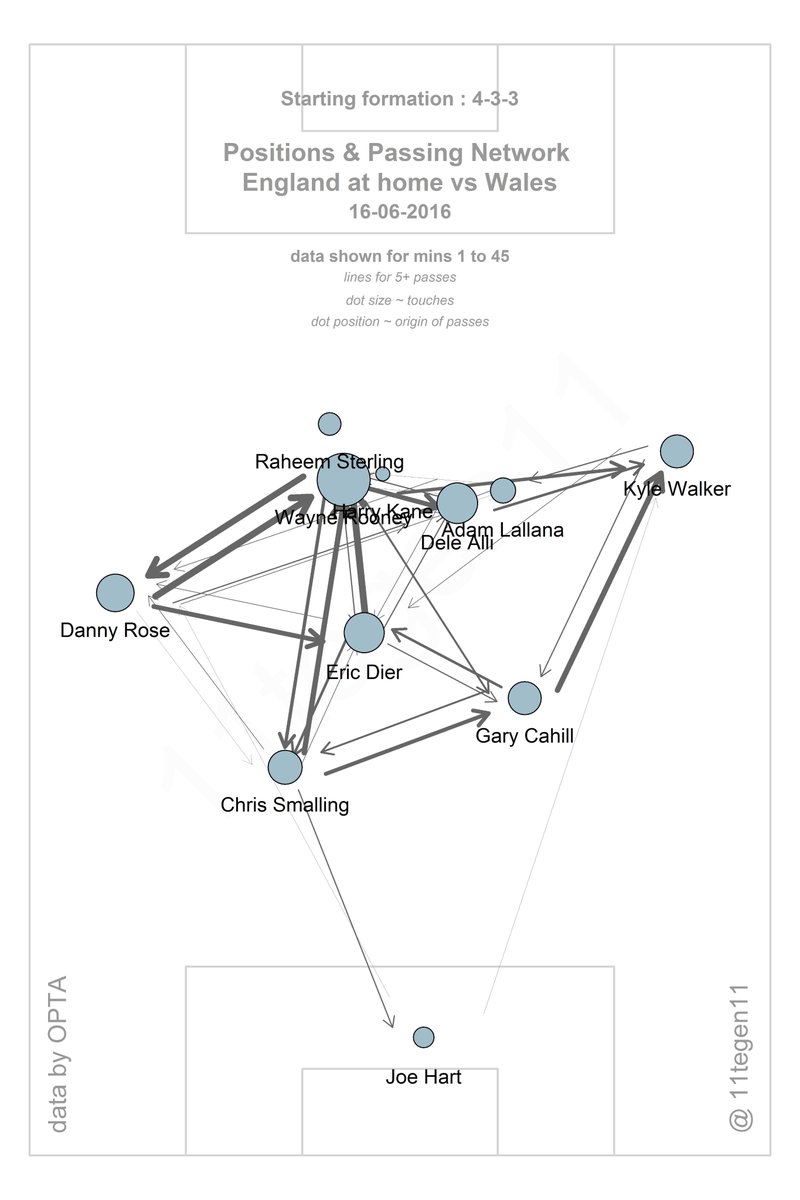
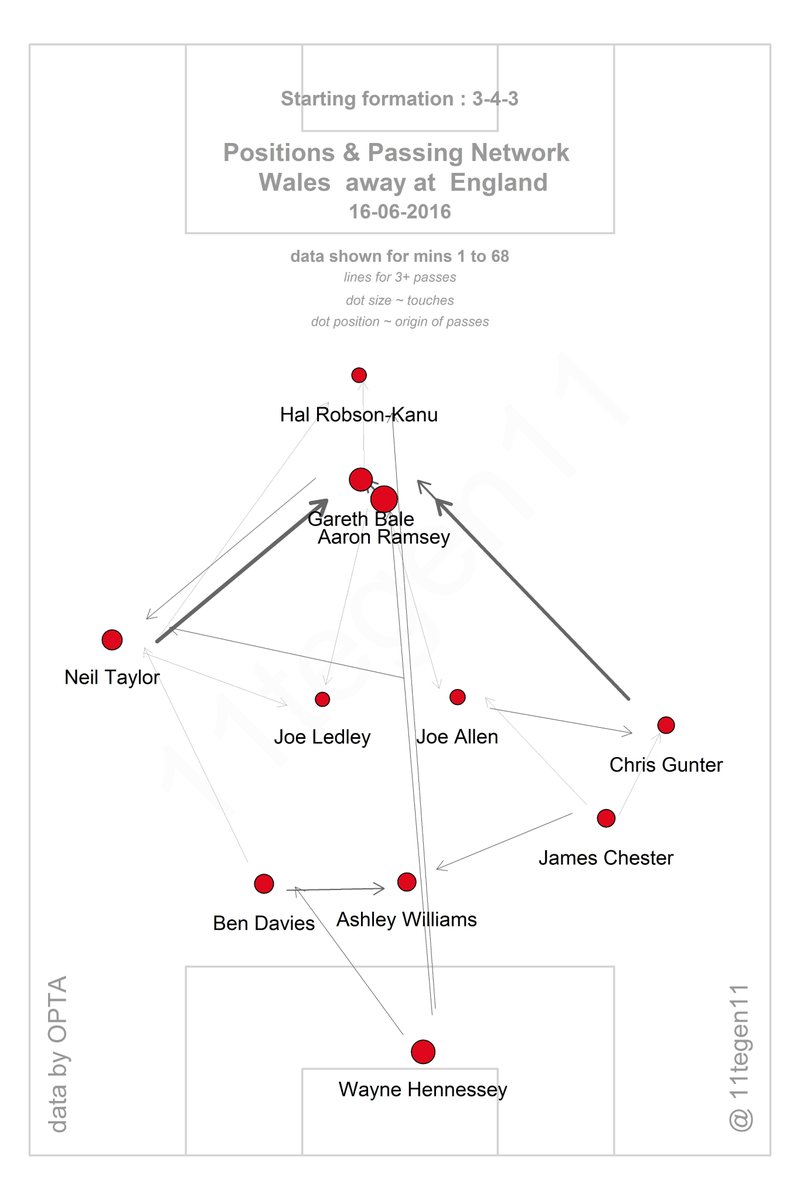
Against Wales, the 5-2-2-1/5-3-1-1/3-4-2-1 thing that they play was difficult to break down due to Allen and Ledley dropping to the edge of the 18 yard box to protect Williams, Chester and Davies (the three centrebacks) meaning that the 'good' positions to score (central, around the penalty area) were congested as hell. Moreover, the full-backs were happy to be pinned back to stop the cross - and despite this, England still created some chances, some half chances. Mega deep.


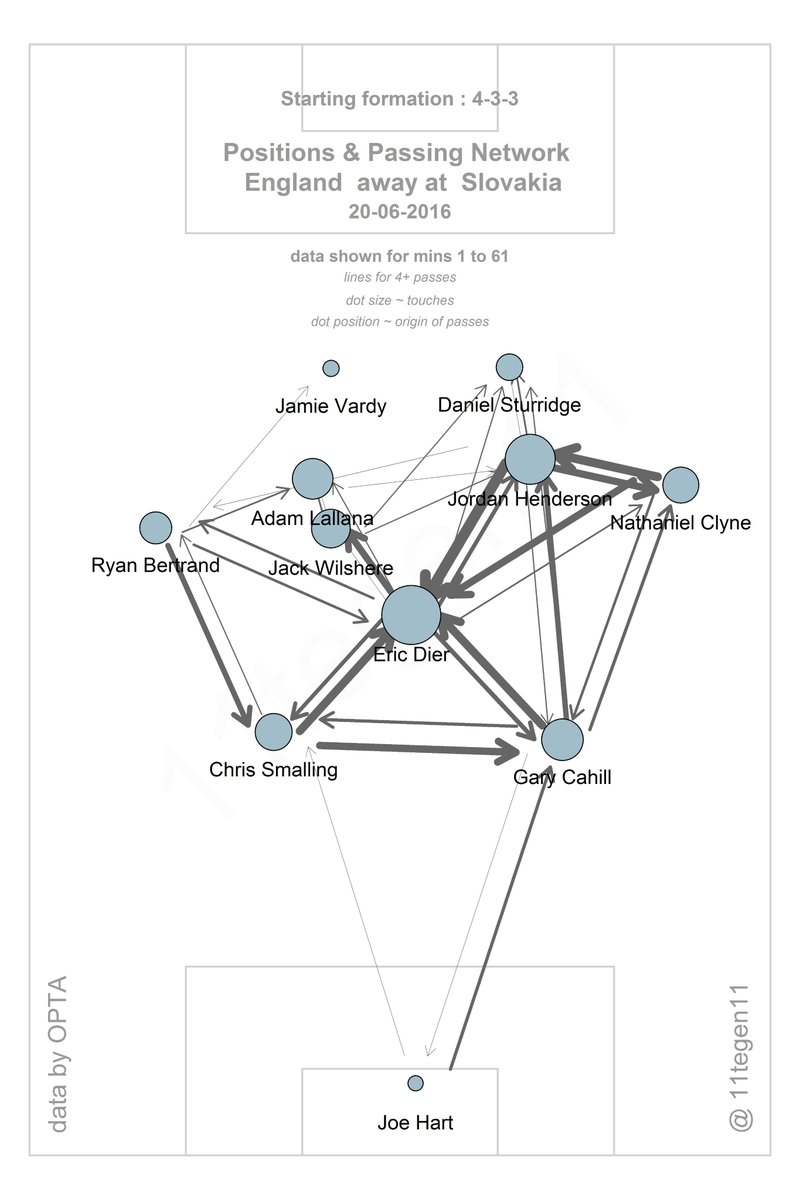
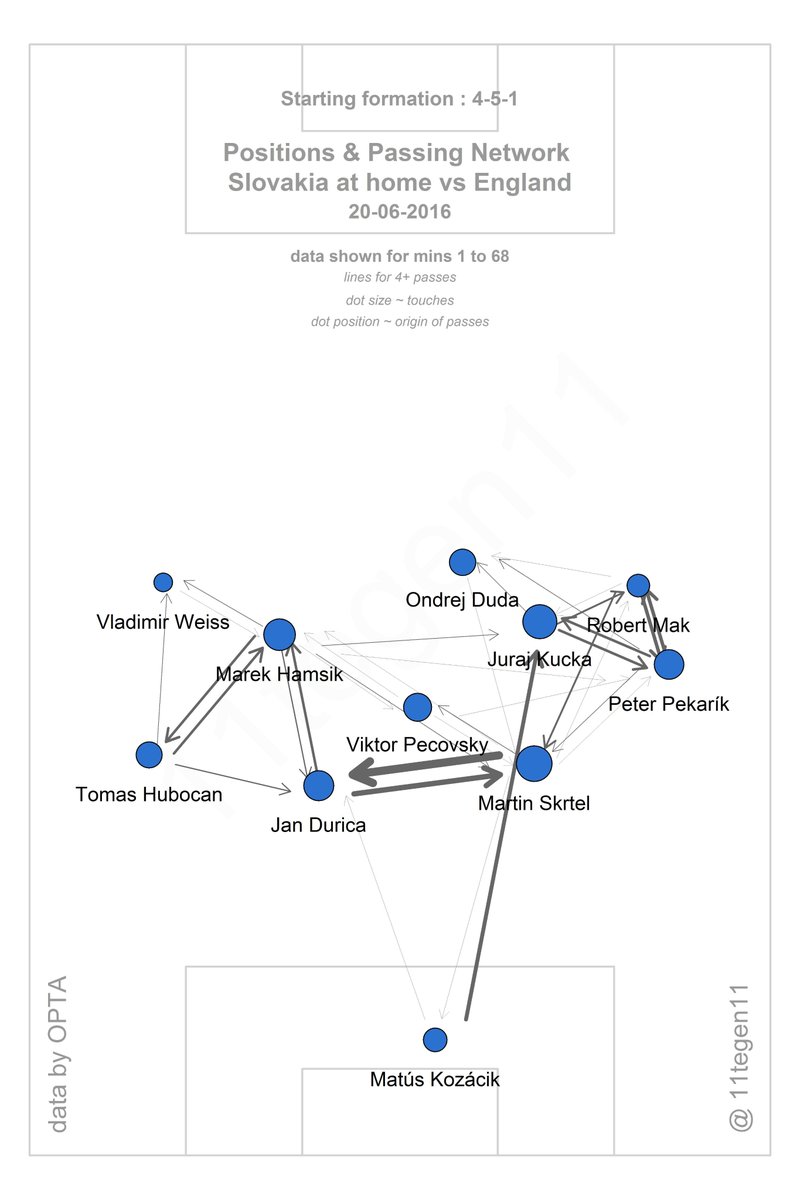
Against Slovakia, England faced a team who didn't really want to play - with a back four who sat deep again, with Slovakia content to play in triangles on both flanks.


In all three of these games, England pressed high, with good ball recoveries in these areas and the players linked up well - But the pass they were looking for in the channels and on the inside space between the 18-yard box/6-yard box was an area which they weren't able to exploit.
And this struggle is why I'm concerned about how England will fare if they don't get a fast start.
Let's take a few things into account;
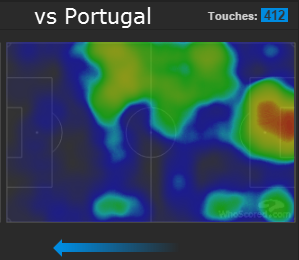
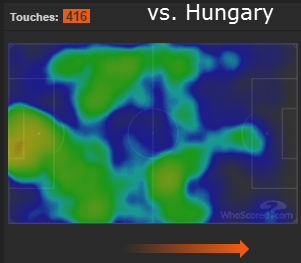
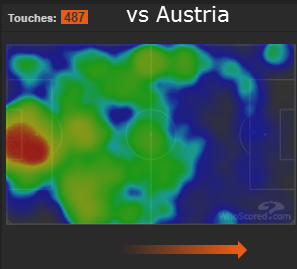
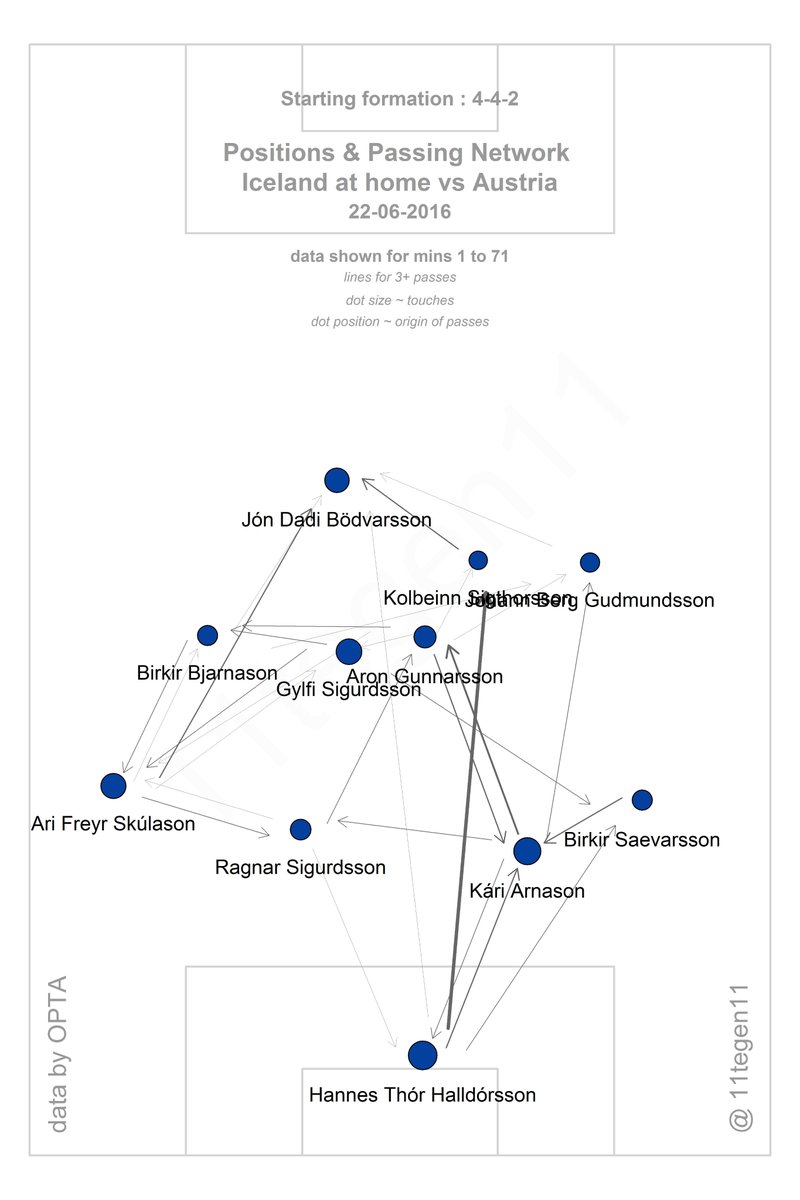
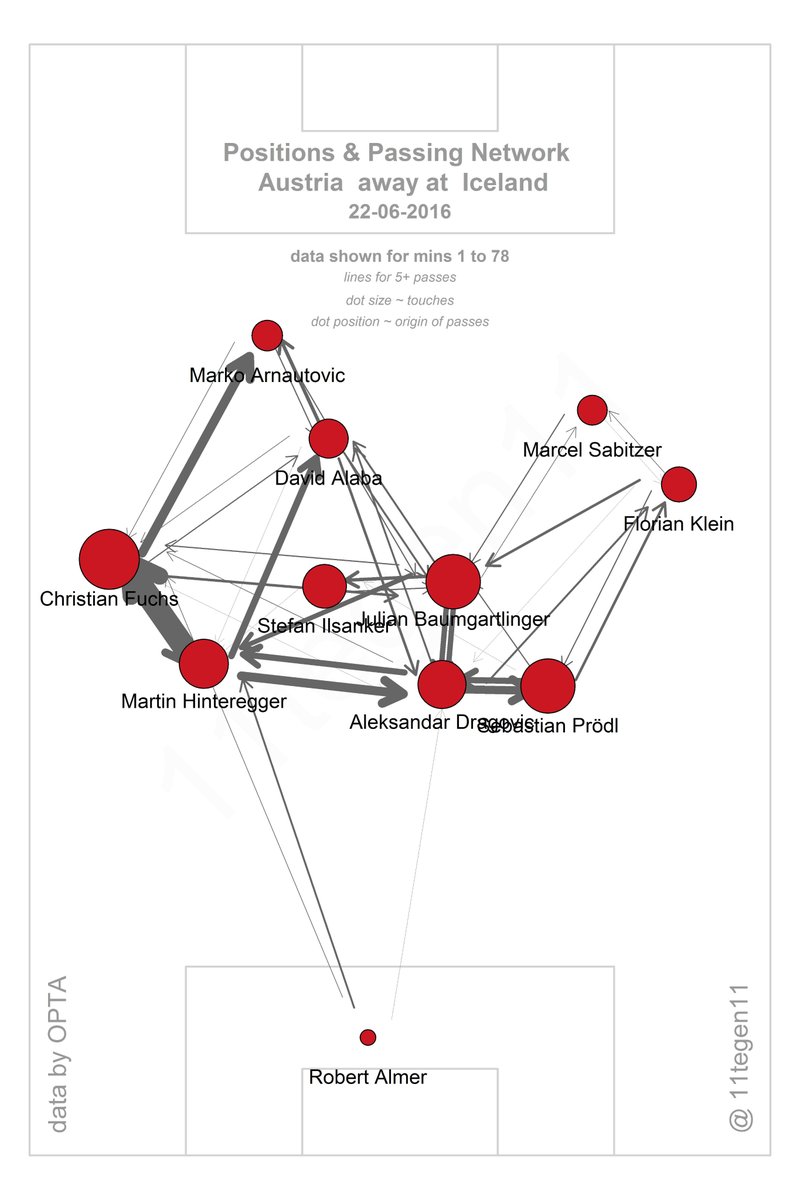
Iceland haven't exactly been dominant in the games they've played in. They've had under 40% of the touches in the games they've played in - with the highest being 487 touches vs Austria (846) at 36.5% of the touches in the game. Further, they don't exactly shoot much - against Austria they took 11 shots - compare that to 4 against Portugal and 8 against Hungary. Sure, you can argue that they're getting more and more comfortable on the ball, and working it into areas where they can take a shot - But more importantly the trend here is tonight is going to be more of the same in this tournament for England... A well drilled formation who will be hard to break down, and will be happy to not have the ball and break when they can.


Conversion rates is something that England have to be wary of - Having not been able to finish their dinner vs Russia and Slovakia, and using all 5 strikers against Wales, it's not been a shining performances for a team who have often been mentioned with respect to the 'quality' and 'options' they have in this area.
Iceland have been the opposite - a conversion rate of 25% vs Portugal, 12% against Hungary and 18% against Austria - You can infer that when they get their chances, they take them. Cahill, Smalling and Dier will have to be alert - And more so will Joe Hart, who has looked a bit shaky on crosses this season. (I am definitely not a goalkeeping expert, so I'll skim over this part)
Formations
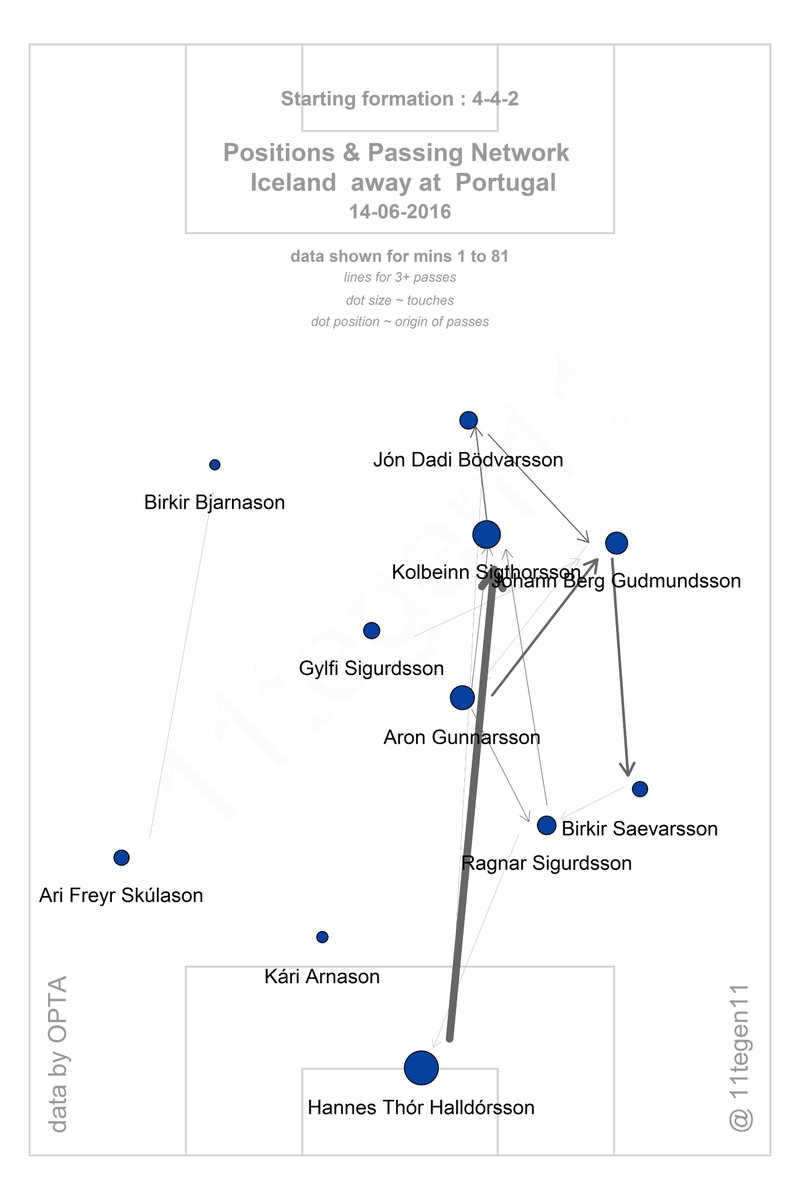
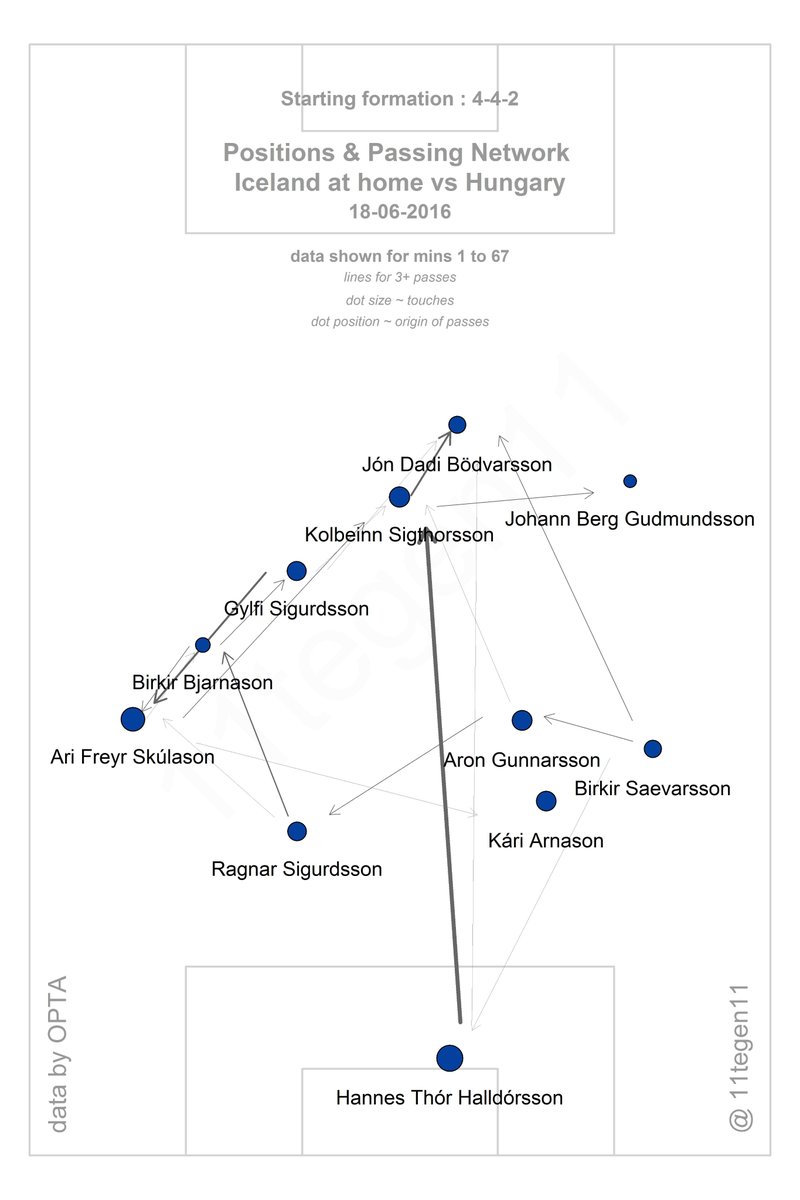
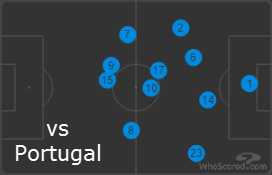
Iceland seem to play a flat 4-4-2, and what's worse, is they play direct football - Truly the Leicester's of this European Championships! Their 'star man' Gylfi Sigurdsson has been occupying a deeper role as a central midfielder, but in reality he has been all action - from the way they seem to play you can see that the 'route one' option is for the goalkeeper to go long and hit their big man - Kolbeinn Sigthorsson, with last minute hero Jon Dadi Bodvarsson the man who's the highest up. The team as a whole seem to enjoy be successful at contesting long balls, with the 2nd highest success rate of aerial duels, second only to (surprisingly?) France.


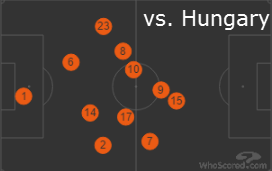
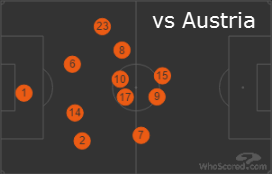
The right hand side seems to link up often too, with Gunnarson being the link between the midfield and defense. However, though the right hand channel seems to be favoured against Portugal, it doesn't seem the case in the games against Hungary and Austria. In terms of shooting potential, it seems to be largely Sigurdsson and Bodivarsson taking their shots, and the pass accuracy is a 60.9% - The lowest in the tournament. (average positions below)


Teams, Teams, Teams.
England will be content to have the ball, but I feel that England will need someone like Raheem Sterling and Danny Rose on the left, with the Clyne-Lallana link on the right which looked very good against Slovakia. The question comes to midfield; Rooney will inevitably start (he's been calm, assured & gives a scoring option) (God, I sound like a United fan) (But he's not _completely_ awful, and still has ), but who alongside him? This all depends on who's up front.. If Sturridge continues then Henderson should surely get the nod. Secondly, starting Henderson or even Milner gives a) legs in midfield (to support Dier on the inevitable long ball counter attacks) but also the 'Liverpool' flank on the right. These club relationships will be vital in the coming rounds, I think; and b) that Dele Alli is a great option off the bench - Whilst, lets be honest, bringing on Henderson or Milner is hardly a substitution which strikes fear in the opposition hearts, and will rarely excite any crowd at Anfield, let alone at the Euros.
I envisage Roy's team may bring in one of Milner and Henderson to sit with Rooney and Dier, Sterling will return on the left and Clyne will take Walker's spot. With Lallana and Milner playing, there's (again) potential for England to change formations from 4-1-2-3 to 4-1-2-1-2 or even 4-2-3-1 - However, I given the doubts about Lallana's fitness, I wouldn't be surprised to see a front three of Kane, Sturridge and Sterling - With Sterling offering the option to play as a #10.
And this is what I like about this England team - There's a dynamism that hasn't existed before. And as long as they can get a fast start to get Iceland to come at them, I envisage a good game for England. My only concern remains Hodgson's game and player management - As to who comes on for who and when... Especially if England are being frustrated again up till the 60th minute mark.
Conclusions
On paper, this should be a very routine win - The Icelandic players will be hungry, and excited but will be told to play their disciplined compact game and play to their strengths. Key for England is to be dynamic through the game, change systems and re-capture the fantastic movement we have seen by them in glimpses in this tournament. And for me, getting an early (0-25 minutes) goal is *vital*. It means Iceland have to come out and meet England, England can drop into a passing rhythm - But protecting the lead means discipline, which is where the experience of Cahill and the quality of Dier hopefully will shine through. England should be hungry - They've had two extra days off because they didn't top the group, to rest, prepare, train and develop. As @unfitforpurpose mentioned on Twitter - the bizarre thing is, the players seem calm and aware of their skills, whilst it's the fans and media who are whipping up a frenzy.
As I've bleated on throughout, this could be the tournament where England actually manage the tournament, than trying to get off to a fast start - the momentum is definitely building.
Now is the time to make it count.
Sunday, 12 June 2016
England vs. Russia | It wasn't that bad..
Anonymous
08:00
analytics, england, football, soccer
No comments

This is possibly the best England team I've seen.* *I emphasise the word team here. Lots of caveats to this statement such as 'in parts', 'team performance', 'cohesion', 'understanding' etc. It's a sensationalist statement to draw you in. I think. I hope.
The first major England tournament I remember is World Cup 2002. The final was on my birthday, and England were knocked out by Ronaldinho looping it over Seaman. I still don't think he meant it. I've gotten excited by the prospect, but I don't recall seeing England play this well at a finals. Perhaps I appreciate the game more. Perhaps, as one passionate tweeter suggested yesterday, I'm blind. But I actually believe this.
England kicked off their campaign yesterday with what I would call an 'encouraging draw'. Pundits, however, would probably call it 'a draw which feels more like a loss'. In my eyes, England have been slammed in the past for not understanding tournament football - and that's where the small irk about potentially poor game management vs. Russia comes in. However, that said, a slow start is never a bad thing. Tournament football in it's nature is a game-by-game thing. It really depends on how the lessons from Marseille are learned, built upon and improved.
Let's start with something great; I loved this move by England; the movement and fluidity between the players in white is great, and (admittedly helped by poor Russian positioning), the right hand side was very fruitful.
The full-backs were fantasticThis is so quality from England. Vertical pass to switch to an advanced wide area, then a third-man run combination. pic.twitter.com/qVmrG1uwx5
— István Beregi (@szteveo) June 12, 2016
In the first half - England were really, really good. I almost typed sensational, but I was lambasted on Twitter for enjoying England's overall performance last night, so I'll keep the tone lower. The fact was, they pressed well, the full-backs - across the entire game for me - were sensational going forward. In Kyle Walker, we're finally seeing a player with the pace, power and dribbling nous to get ahead on the over- and under-lap to cut back for one of the central players to shoot. The pass to Rooney was one of a few times I can remember a full-back for England getting past his man, and asking questions of the masses of Russians in the middle of the box. And then we have Danny Rose - The drill across the 6-yard box was begging for Kane or Alli to surge past any man who stood in their way to nick something onto it.
![]() |
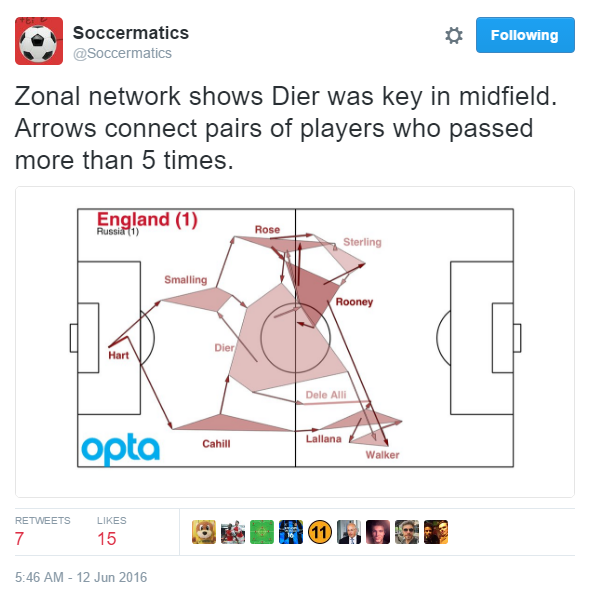
| Credits for David Sumpter of Soccermatics - Check out his book! |
As you can see above in the graphic by David Sumpter, the passing frequency between Rose, Dier and Rooney is immediately striking, as is the average position of Walker - he was such a pivotal outlet on the right hand side.
Can't win games unless you finish your dinner
The Wales game earlier in the day highlighted that the most scrappy goals can be the most important - And for all their dominance and wonderful display, England could not find that level of scrappy-ness in the first half to force the Russians out of their shell. Look at this average position map - Russia effectively had 6 across the back line 3 or 4 times in the first half, with the full backs really pinning the wide men back. My favourite part was the trust Walker and Rose had in Dier, Smalling and Cahill to be alert to any counter attack. The role of Dier, as highlighted below, cannot be forgotten.

I'd let Eric Dier protect me and my family
Admittedly, that's a bit far and quite superlative, but my point is thus. The role that Dier played last night was immense. Apart from the outrageous free-kick he struck with absolute beauty, he had a dominant performance. Playing the role of passing recycler, he finished the game with 81 touches of which were 68 passes and a passing accuracy of 89.7% (61/68 completed)
And hey. While we're on the subject, lets talk about the passing ability of that England line-up. An average passing accuracy of 82.9% - And that's excluding Hart (60.7%). A long way from "conservative" "long ball Woy" I have heard in the past.
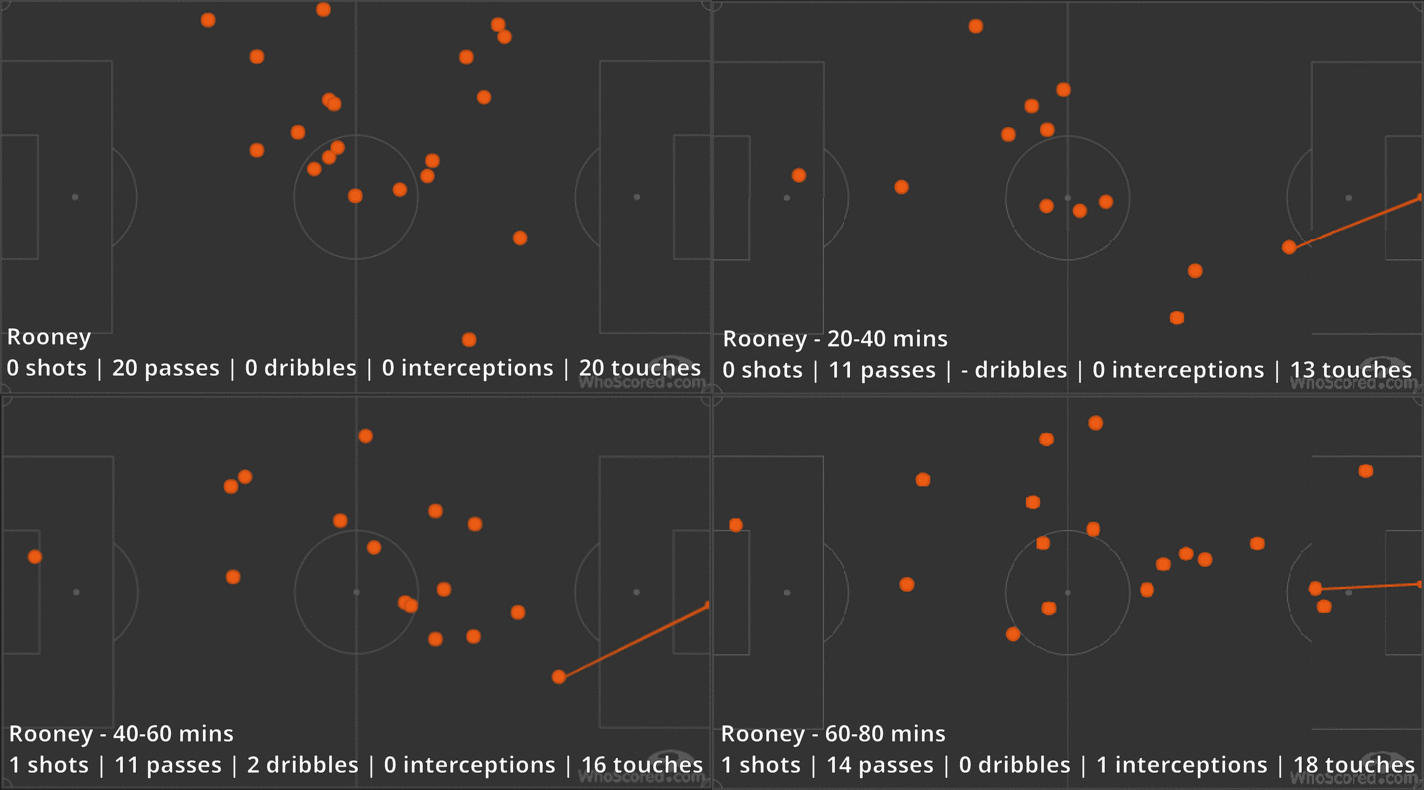
Did Rooney tire after 50 or so minutes?
The decision to substitute Rooney was blasted after the result. "Why sub the captain" people cried (of course, these same people wanted Rooney no where near the starting eleven before the game kicked off) "He's been terrific tonight" they cried. But was there something missing from the latter end of his performance? Let's have a look at his touchmaps. I've spit it into 20 minute chunks.

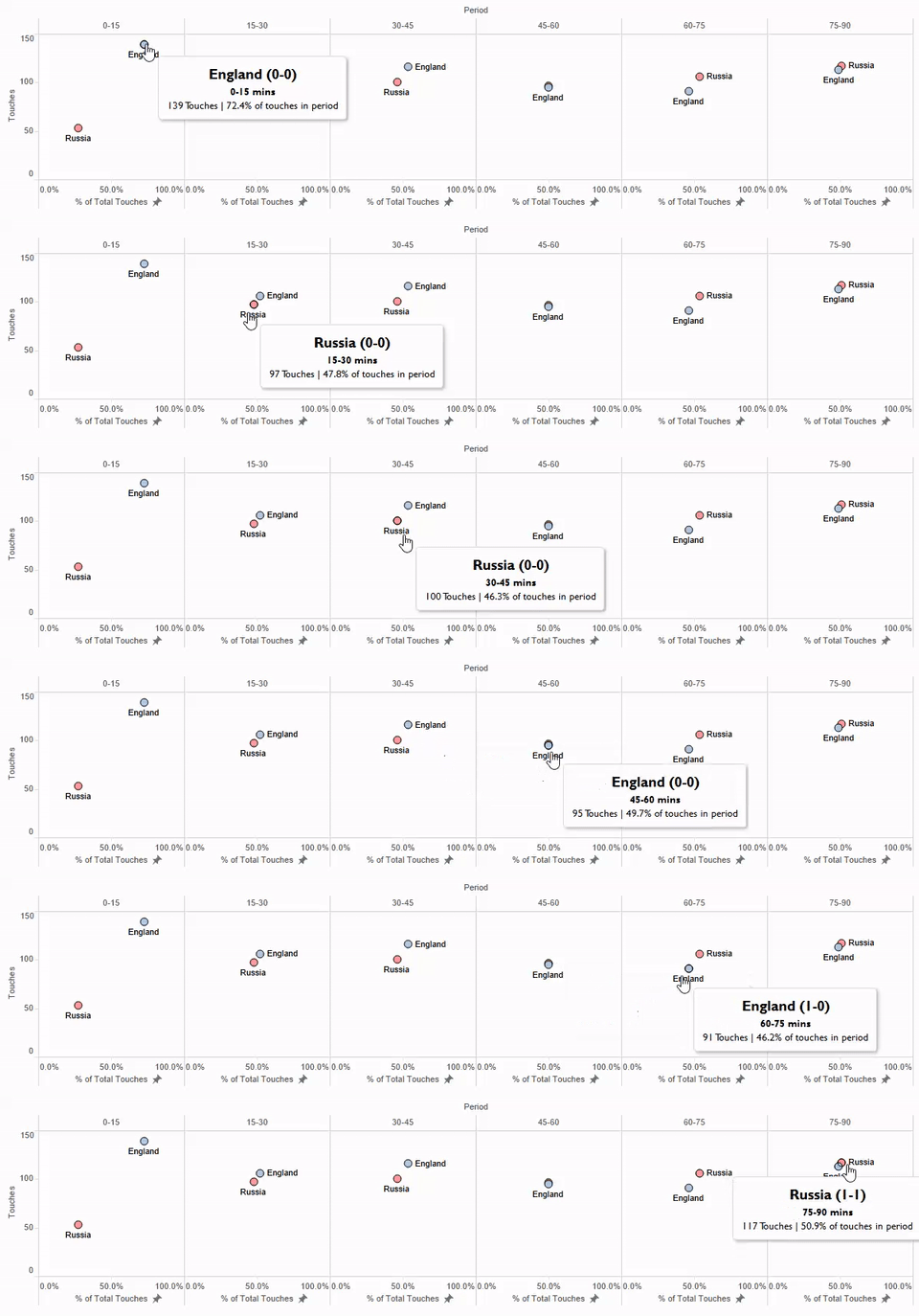
So perhaps there isn't *really* anything to be said about that apart from the eye test. After having a look at this, I got to thinking. How did the 'touches' that each team took change at each stage? From the narratives, England bossed the first half, had a poor start to the second, a solid middle, and a bad end. Does that story follow?

Yeah - It seems like the goal was coming. Russia took it upon themselves to dominate the game, whilst the in the first half an hour, looked to take the game to Russia. It's just a shame that pure clear cut chances weren't created.
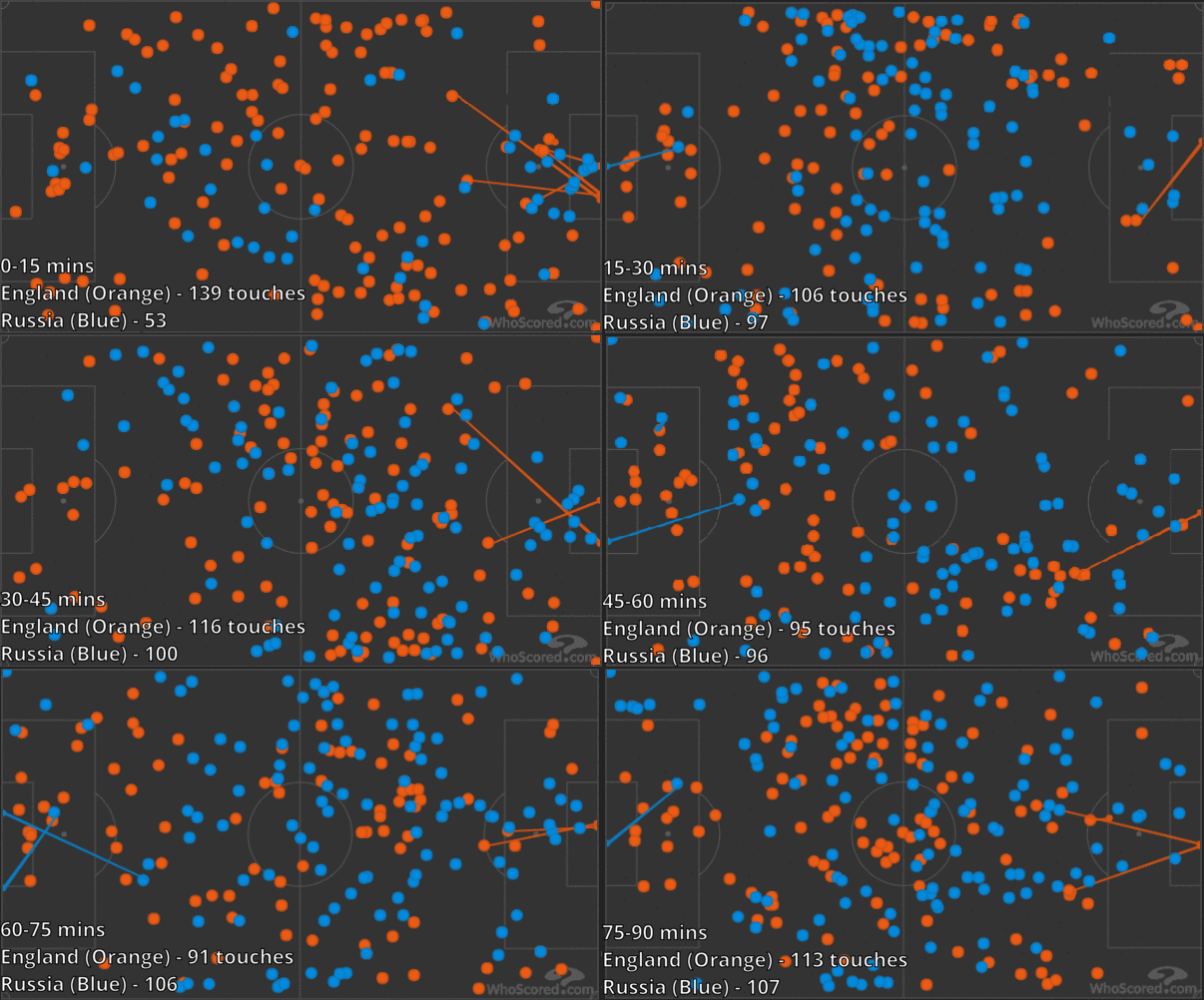
A slice more of context? Why not.

You can actually see the blue dots (Russia) growing more dominant, especially down their right, England's left. Something to be wary of, perhaps. But that first 0-15 minutes. Wow. England actually dominated.
Game management - What to do to 'see it out'?
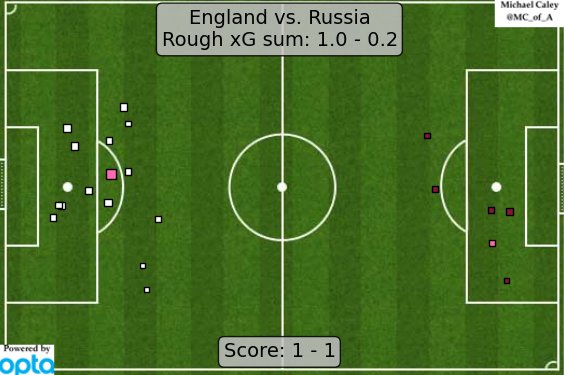
Much was made of Roy Hodgson's substitutions. Many didn't rate Kane, Raheem or Lallana in the second half (perhaps they have a point, perhaps not) and admittedly, it might have made sense to bring on J*mie V*rdy to run at the centre-backs of Russia. Who, actually, I thought had a very good game. Both of them knew their strengths and weaknesses, and were rarely drawn out of position by the England attack (apart from perhaps *that* Rooney chance which Akinfeev saved magnificently). I felt like they used every single year of their experience to their benefit to keep England out of the 6 yard box. Which worked really well (see Michael Caley's ExG map below; larger dots, clearer cut chances, the rough sum being rough sum of the probability of goals England coulda shoulda woulda scored from the shots they took etc)

Back to substitions, the name James Milner screams calm, effective, conservative play, and perhaps he should have replaced Raheem Sterling earlier - Or even Rooney, if it was inevitable that Rooney was coming off. The fact that Rose likes to marauder forward to great effect means having someone like Milner who runs tirelessly all game can help the foil - But you lose the direct running of Sterling (though, his ability to pass early, or shoot at the right time will be one of the first things that Pep sorts out. I hope!)
Conclusions, and Wales.
The best part for me is that England could have been carried away by one brilliant game had they won comprehensively. This allows the squad to experience and learn from their mistakes. No doubt the backroom team will have each player assess their own performance and I am almost certain that we will see a very different England. Because of poor performance? Because of the frailties we saw?
No. I feel like Roy actually has been smart about this and will change the team and system depending on the opposition he is facing. Analysts must have watched footage and understood how Wales and Slovakia play. The Welsh game is fascinating for two reasons; first, to see how each team reacts; and second, because of the 5-3-1-1/3-4-2-1 formation thing that Coleman has them playing. The flanks and middle will be overloaded, and Wales will also look to sit and hit on the counter. The amount of long balls that Wales hit (84) is the highest of the tournament so far (not including the games today [Sunday 12th])
So, yeah. I felt OK after last night. Nothing from the chances England had screamed WE WOZ ROBBED to me, and I can understand that the goal was unlucky. However, 1 point is better than 0, and I honestly believe that this young squad played some scintillating football last night in periods - Just were lacking that final spark.
My message to the wonderful folk who have got to the bottom of this? Keep your Spurs & Leicester biases at home, take these 23 players at their merit and enjoy the spectacle. There's some great football to be watched if you stop tutting when England fail to cross into the box early. Watch the movement, the direction of play & the cohesion + players understanding each other shone through across the team. Last night was a good start, and there's so much to improve, I feel genuinely excited.
Finally, England actually played well in a game at a tournament - I can't wait to see what's next.
Thursday, 7 April 2016
About Mick, Marcus & some things on analytics
Anonymous
08:00
football, itfc, soccer
No comments
A caveat before I begin; been ages since I posted on Twitter, and am far more active on Twitter - but a conversation or two over the last few weeks (and ITFC Twitter being overrun by crappy generic 'fan' accounts), I'm back here to get some long-read views out & maybe start a discussion which invariably will go off on a tangent.
First; Mick McCarthy - This season is the plateau where many are seeing how so much came good at once last season (albeit less so in the second half). I appreciate the functional style of play, and note that Leicester do it similarly (albeit, so much better) but this season has been a bit meh - so much, that I've not blogged about their #numbers all year - and probably won't until the end of the season now.
What to do if 'MM leaves for Villa'? Let him - He's a good bloke, knows his skills and limitations, and for me the last few games have echoed his time with Wolves in the Championship. The draw specialists, who circled around mid-table for a while before hitting it right. If he doesn't leave, in my eyes he has two transfer windows before parting ways at the end of next season - Barring any categorical disaster or success.
The main issue for me is this; The state of a) the squad and b) the 'philosophy' that is employed by Ipswich Town FC is tailored to these players by emphasising hard work, specific shooters and a firm back line. This year, Town have had issues with injury, but there hasn't been a single XI who have backed themselves as THE best 11. And this is a shame really.
So, MM leaves and Manager X comes in - The state of this squad means ME should either hire someone similar to Mick, or slightly more modern than him in terms of style of play and type of player. This takes us to the train of thought of a 'transition' manager before settling on a new model of success after the transition has been completed.
And all of this takes the biggest commodity in football - Time. The disparity between the PL and Championship is growing year by year, and it's becoming tougher and tougher to compete. But, shy of taking a huge gamble, risking relegation & pressing the reset button like our East Anglian neighbours, I don't see any solution other than the two options; a go between, or a gamble.
I touted Nigel Pearson last night, not the most fashionable choice, but I was lucky enough to meet a couple of the Leicester analysts at the Opta forum, and the latter half of last season was Pearson drilling the team to work hard, power through and ensure survival - And it struck me to be akin to the MM model. Again, the caveat remains it would be a 2 year deal where he would move the club toward a more affable style of play, but this period for me would be key. First, to introduce and develop academy prospects and second, for the internal structure of the club.
I think Ipswich should move away from the white, British, between 45 and 55 years old with some sort of historic success in the Championship approach, and implement a proper strategy and a way of thinking to help advance the club. As some of you may be aware, I'm a fan of the anaytical approach but one which bases itself on championing coach knowledge to be combined with additional insights that data can provide. Average player positioning, on-the-ball actions & development of tactics, styles and such are all possible in conjunction with the right amount of data. And further, having the option of academy data really can help track progress of a player & further understanding. In my eyes, there's so much that Ipswich could do better here - starting with *actually* having a presence in this at the Performance Analyst level, beyond simple video analysis & scoreboard stats. Norwich, believe it or not, have a remarkably structured platform for this, and are doing some annoyingly smart things with both data & their academy development. (And I wrote to Ipswich three summers in a row, asking to propose something/help in this instance with no reply - probably asking the wrong people)
So; my three take aways;
1 - If MM leaves, Ipswich have options but it would leave us in a lurch as the squad is neither here nor there at this point
2 - When the next manager comes in, the choice for ME is to either be radical with a new coach, a new coach + DoF, or a transitional coach while developing a new structure
3 - Modernise backroom/club activity to keep up with the modern age
Thanks for reading! Thoughts welcome.
Tuesday, 29 December 2015
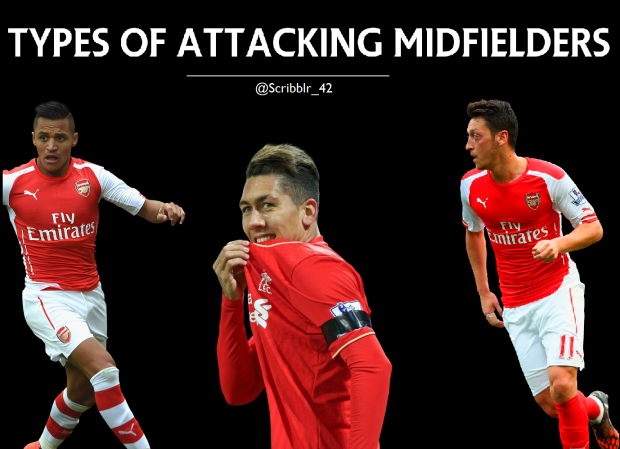
Different types of Attacking-Midfielders; a thought starter
Anonymous
08:00
afc, analytics, firmino, football, lfc, ozil, sanchez, soccer, tableau
No comments

Disclaimer; this post isn't about Ozil. Much.
Mesut Ozil is killing it this season.
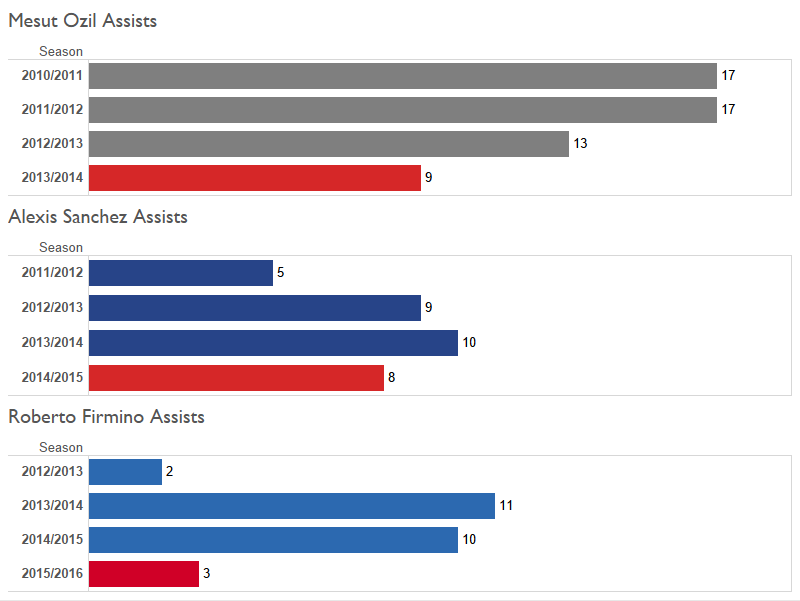
With over 15 assists already, the German international is on course to hit and surpass Thierry Henry's record of 20 assists in a Premier League season (anyone else unsurprised that this is another Arsenal player under Wenger who holds this accolade?) - But what shouldn't be forgotten is the stick that Arsenal's record signing got in the first season and a half he spent in North London. As the narrative goes, Mesut was not a big game player nor was he the type to be prolific in front of goal.
This tweet by Simon Brundish got me thinking; how long should different types of players be given to make an 'impact'?
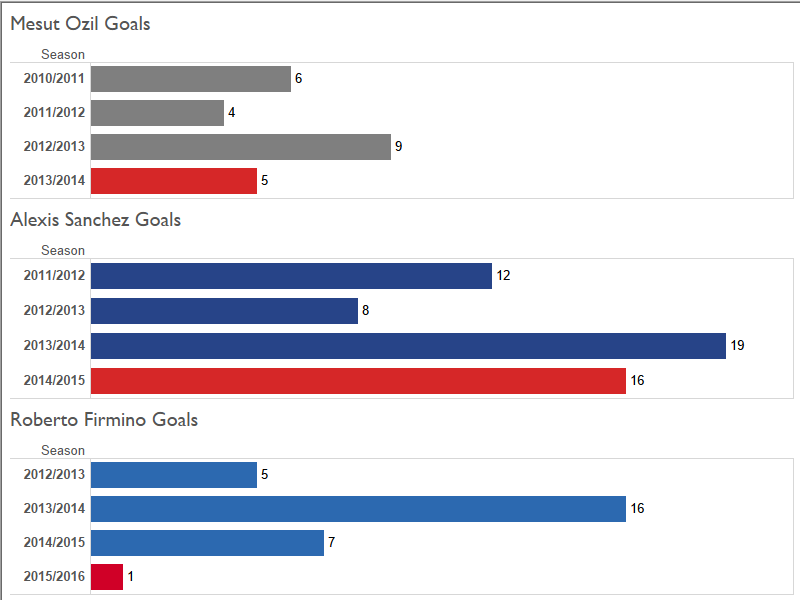
Let's examine another player alongside Ozil; Alexis Sanchez. Arguably, he also counts as an attacking-midfielder and I'm sure it cannot be argued that his debut Premier League season was better than Ozil's.Where Ozil played 2150 minutes in the Premier League, scored 5 goals and registered 9 assists (a scoring contribution of 0.586 per 90) in his first season, Sanchez played 2953 minutes, scoring 16 goals and 8 assists (a scoring contribution of 0.732 per 90)
So Alexis had a higher impact; but ultimately, they are two very different attacking midfielders. Where Ozil is a 'creator' and a orchastrator, Alexis is perhaps more direct. Let's see if this hypothesis holds.
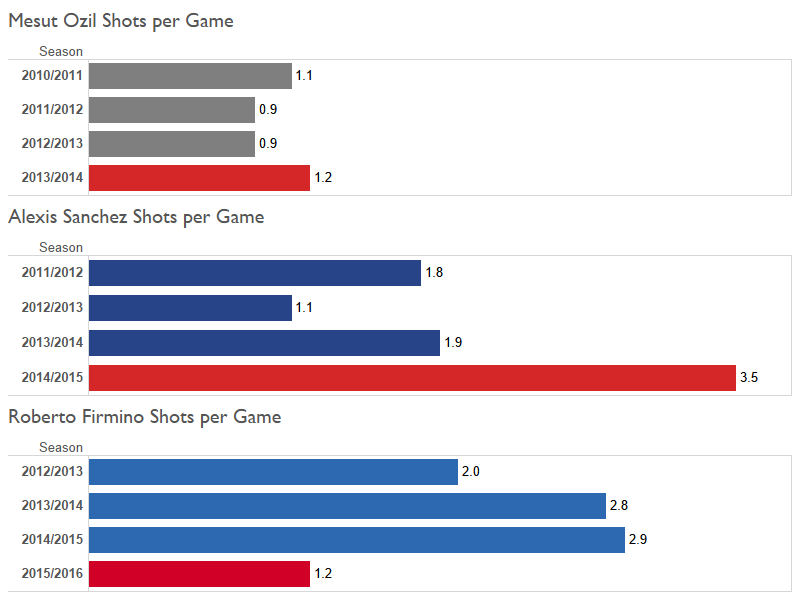
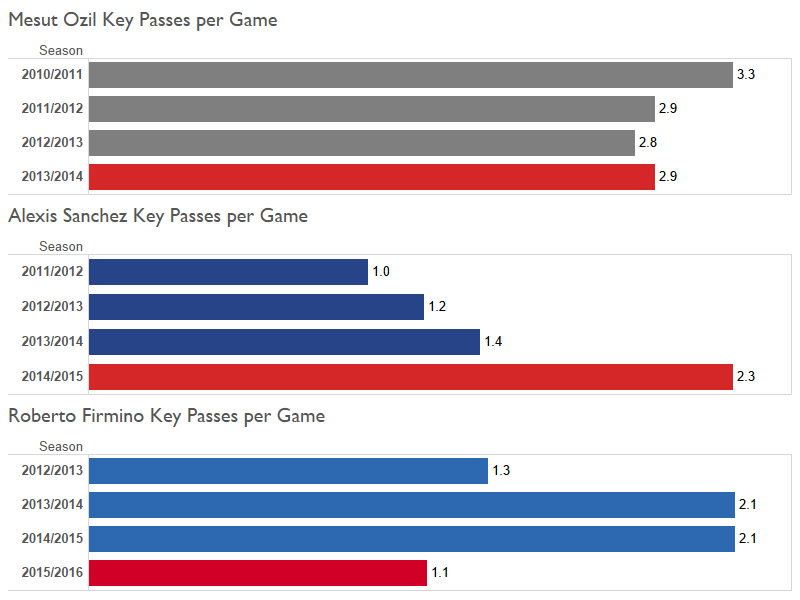
Alexis took 3.5 shots per game, made 2.3 key passes and attempted 3.3 dribbles per game. Conversely, Mesut's first season yielded 1.2 shots per game, 2.9 key passes and 1.7 dribbles.
Already we can see Ozil's emphasis on creating chances than attacking a full back, and perhaps this is why he tended to play narrow for Arsenal even when placed on the wing.
But the secondary factor is this; where Alexis' game relies upon getting the ball, attacking individually, receiving and letting shots fly, Ozil needs to have the movement, space and time to pick out the passes he wants to make. And this would require the players around him to also understand his game.
The purpose of this post is Liverpool's #11, Roberto Firmino. As a rule of thumb (which stems from probably a comfort with multiples of 5), pundits refer to a great midfield player as someone who posts 10 goals and 10 assists a season.
In Ozil's three seasons with Real, he averaged about 6 goals and 15 assists per season.
Alexis at Barca in his three La Liga seasons averaged 13 goals and 8 assists per season.
So where does this leave Bobby Firmino? In his last 3 seasons at Hoffenheim, he averaged 9 goals and 8 assists a season - so perhaps a bit more balanced than the examples examined above. Last season, he took 2.9 shots per game, made 2.1 key passes and 4.2 dribbles - which actually points him to be closer to Sanchez than Ozil in this comparison - his scoring contribution was (in 2918 minutes played) 0.524, with 7 goals and 10 assists. These came in 33 starts, and was slightly down from his previous season. Another factor to his slow start at Anfield could be starting every game two seasons back to back, and representing Brazil at the Copa America this summer.But I am no sports scientist and cannot speculate on this in an informed manner.


Using just one example of comparing Ozil and Alexis (given their 3 season stints in Spain prior to joining Arsenal), this could be a reason why Firmino is taking time to bed into Liverpool.From my understanding, attacking midfielders can be 'a Sanchez'; a direct runner, who takes a lot of shots, is good with the ball at their feet. Or, they could be more of 'an Ozil'; less shots, more creativity, with an emphasis on assisting than scoring. The latter I feel requires a few things.
- Understanding the role; making sure that the role and all the tasks a player has to complete on the pitch are understood and being met - and that they are comfortable doing so
- Cohesion with teammates; for Ozil, players need to trust that if they make the run, Ozil can find them, and similarly that if they are to utilise his creativity, the man needs space. This positional understanding, trust & chemistry are important to ensure moves look as fluid as they can.
- Acclimatising mentally & physically; this includes on and off the pitch. On the pitch, the pace, space and movement need to be adapted for the environment an attacking midfielder finds themselves, and off the pitch, the club should ensure that the player is in the right state of mind to perform and 'hit the ground running'
In this vein, I feel that though Firmino may not have sparkled, his passing networks and interplay with his team-mates will increase similar to Ozil's has, and he possesses the ability to run at full-backs and contribute in a way that Sanchez can. It'll be interesting to see how Klopp utilises and changes the use of the Brazilian midfielder.